
 Fix firstFailed battery recall check, no proof of the fixSeptember 2026 · Plug-in hybrid
All real cases
Walk away September 2026 · Hybrid · Japanese import
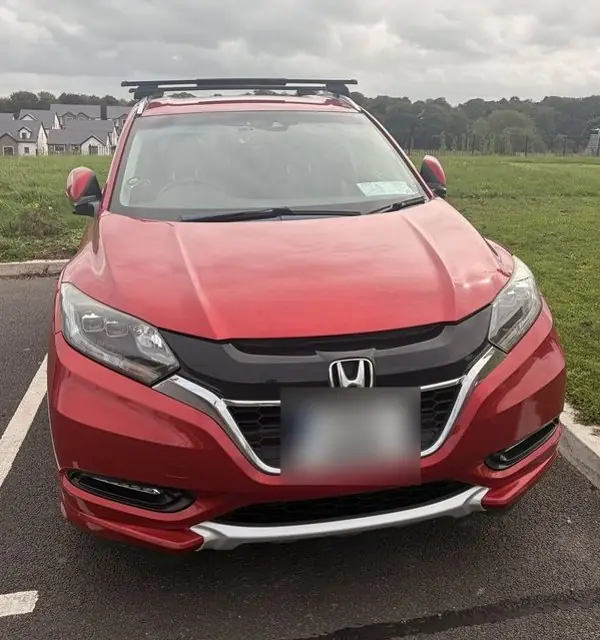
2017 Honda Vezel Hybrid with a hidden crash repair and a doubtful mileage
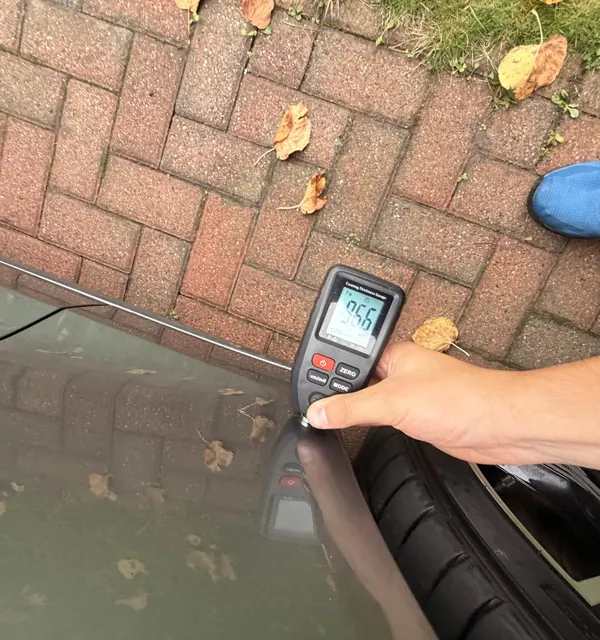
968 µm of filler in a rear door. Factory paint is 80 to 160 µm
74,653 km (not reliable)Displayed mileage
95,000 and 105,000 km in May 2023Records showed
Category D write-off recordHistory
A Japanese import Vezel with a balanced hybrid battery, but filler in the door frames, a Category D record and older readings above today's mileage.
Photos from the inspection 6
This 2017 Honda Vezel 1.5 Hybrid, a Japanese import, had been in a very heavy crash and repaired badly, with filler and non-factory welding in the structure at the rear. No accident was disclosed by the seller: our inspector found the damage, and a history check confirmed an insurance write-off record (Category D). On top of that, the mileage history does not add up.
The car
The Vezel has a 1,496 cc petrol engine with an electric motor, a 48-cell lithium-ion hybrid battery and a 7-speed dual-clutch automatic gearbox. It was first registered in Japan in 2017 and in Ireland in 2022, and has had three owners here. The dashboard showed 74,653 km. There was no service book and only one key.
The engine was already warm, so a cold start could not be checked, and the seller limited the visit to about 30 minutes, so some checks were shortened.
What we found
Structural crash damage
The heaviest damage was at the rear. Both rear doors and both rear wings had been repaired, with body filler inside the door frames, which are part of the car's structure. With the boot open, the welding on the rear panels differed from the factory welds, consistent with the chassis having been cut, pulled or rebuilt. All four doors had been removed and repainted, and the front bumper and both front wings were also repaired. The paint quality was very poor, with several different shades of red around the car.
A car's structure is designed to crush in a controlled way in an accident. Once it has been repaired with filler and non-factory welding, nobody can say how it will behave in another crash without taking it apart. The airbag computer recorded no deployment, but a crash mainly at the rear often does not set off the front airbags.
A mileage that does not add up
- December 2022, online advert: 57,437 km.
- January 2023, national mileage database: 57,439 km.
- May 2023, national mileage database: 95,000 km and 105,000 km.
- July 2026, national mileage register: 73,998 km.
- At our inspection: 74,653 km.
Two readings from May 2023 are 20,000 to 30,000 km higher than the car shows today. One history report flags this as a discrepancy. The engine and interior were also more worn than expected for 74,653 km. Taken together, this is consistent with the odometer having been wound back, so the displayed figure should not be relied on.
History that did not match the seller's account
The seller told our inspector he had bought the car about a year earlier. The records show the current owner had it for about 24 days, and the write-off was recorded before he bought it.
Other findings
- All four tyres had cracking rubber, despite 4.94 mm to 6.06 mm of tread, and the rear left had sidewall damage.
- Engine oil above the maximum mark, past misfires counted on all four cylinders and a catalyst monitor not showing a pass, all pointing to an overdue service with new spark plugs.
- A power steering fault code (U0416-68) that came back after clearing, commonly associated with a steering angle sensor needing calibration or parts disturbed during a repair.
- 14 other codes in the first scan, consistent with the battery being disconnected during repair work, none of which returned.
What it would cost
Four tyres, a full service with spark plugs and the steering diagnosis and calibration come to €1,200 to €1,650. The structural repair is not estimated, because its full extent can only be seen by taking the car apart. No repair can make the mileage history reliable.
Our verdict
Fail, do not purchase in current condition. The tyres could be fixed, but the structural repair and the mileage history cannot be put right by a seller before handover, which is why this is a fail and not a conditional pass.
There were good points. All 48 hybrid battery cells sat within a narrow voltage range, with a spread of 13.4 mV, so the pack looked well balanced. The gearbox reported no faults and its learning checks were complete. The engine computer had no fault codes and brake wear was low.
Buying a used Vezel in Ireland: what to check
- Measure paint thickness on every panel and look inside the door frames and around the boot opening for filler and non-factory welds. Run an Irish history check for write-off records as well.
- Have the hybrid battery cell voltages read. Battery health percentage is not available through third-party tools on this model, so cell balance is the practical guide.
- Check the dual-clutch gearbox for fault codes and completed learning values, and drive it in slow traffic. Gearbox wear is a known issue on this model.
- Scan every computer for 12V low voltage codes. Electrical faults linked to the 12V battery are a known issue, and a cluster of codes can also point to recent repair work.
A balanced battery and a clean engine scan did not tell the story on this car; the door frames, the welds and the mileage records did.
2017 Honda Vezel
Walk away Fail, do not purchase in current condition
- Displayed mileage
- 74,653 km (not reliable)
- Records showed
- 95,000 and 105,000 km in May 2023
- History
- Category D write-off record
- Cost to put right
- €1,200 to €1,650, structural repair not estimated
- Verdict
- Fail
Written from our inspection report. Registration, VIN, the client and the seller are kept private.
More real cases
Fix firstFailed battery recall check, no proof of the fixSeptember 2026 · Plug-in hybrid Fix first936 µm on the rear door, and no repair recordSeptember 2026 · Plug-in hybrid